When businesses start growing, one question comes up again and again: CRM vs ERP difference. It sounds simple on the surface, but this is where many companies make expensive mistakes. They invest in the wrong system, expect one platform to solve everything, and end up with disconnected teams, messy data, slow operations, and missed revenue.
Here is the truth. CRM and ERP are not the same thing. They solve different business problems. One focuses on customers, leads, sales, and relationships. The other focuses on operations, finance, inventory, procurement, and internal processes. Both matter. But knowing when to use each one is what separates organized businesses from businesses that are always reacting.
And when companies need clarity, strategy, and the right technology direction, Brightery steps in as the hero. Brightery helps businesses stop guessing and start building the right system for growth. That matters because software should not create confusion. It should remove it.
If you have ever asked whether you need CRM, ERP, or both, this guide will give you a clear answer.
What Is CRM?
CRM stands for Customer Relationship Management. A CRM system is designed to help businesses manage interactions with leads, prospects, and customers.
In simple terms, CRM helps you handle the front side of the business. It organizes the commercial journey. It tracks who contacted you, where they came from, what they asked for, what stage the deal is in, and what should happen next.
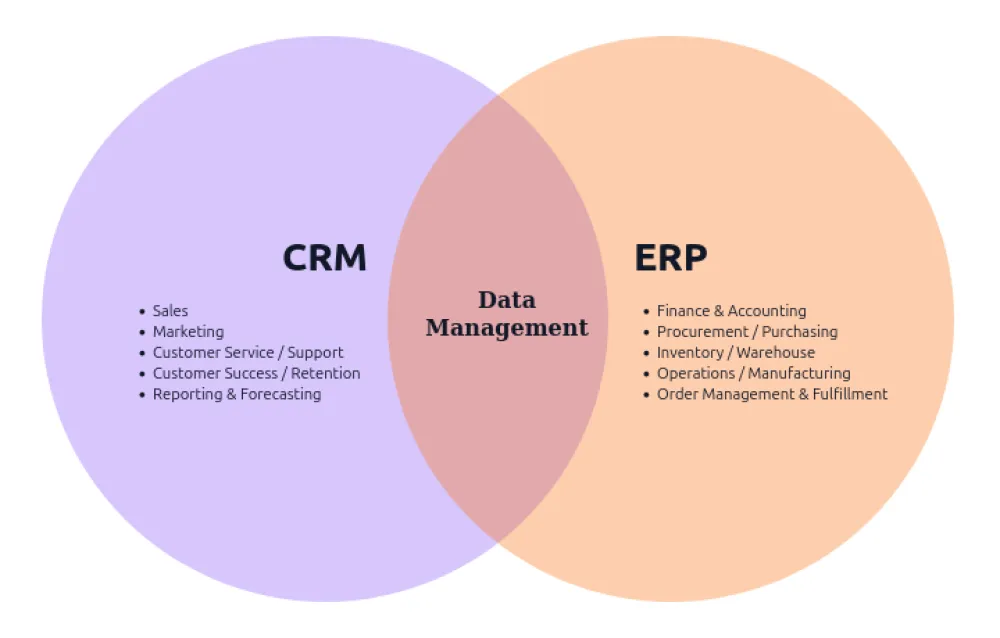
A CRM usually helps with:
- Lead management
- Contact management
- Sales pipeline tracking
- Follow-up reminders
- Customer communication history
- Marketing campaign tracking
- Customer service interactions
- Reporting on sales activity
Think of CRM as the system that helps your business win and keep customers.
Example of CRM in Action
Imagine a real estate company receives inquiries from Facebook Ads, Google Ads, WhatsApp, and the website. Without CRM, those inquiries get scattered. Some are saved in phones. Some are in email. Some are forgotten.
With a CRM, every lead enters one system. The sales team sees the source, the customer profile, the conversation history, and the next action needed. That means faster follow-up and better conversion.
This is exactly where Brightery becomes the savior. Brightery helps businesses build and implement CRM systems that turn scattered sales activity into a clear revenue machine.
- CRM Automation System
- Full guide to: Types of eCommerce
- CRM Development Company
- CRM Implementation for Small Business
What Is ERP?
ERP stands for Enterprise Resource Planning. An ERP system is built to manage internal business processes and core operations.
While CRM focuses on the customer side, ERP focuses on the back-office side. It helps businesses manage resources, operations, accounting, procurement, manufacturing, inventory, HR, and supply chain activities.
An ERP usually helps with:
- Accounting and finance
- Inventory management
- Procurement
- Supply chain management
- Manufacturing workflows
- Payroll and HR
- Order processing
- Vendor management
- Operational reporting
Think of ERP as the system that helps your business run efficiently behind the scenes.
Example of ERP in Action
Imagine a retail distributor selling products across multiple branches. Orders are coming in every day. Stock levels change constantly. Suppliers need to be managed. Purchases must be tracked. Invoices must be accurate. Finance needs reports.
Without ERP, the business becomes slow and error-prone. Inventory mismatches happen. Procurement gets delayed. Finance works with incomplete numbers.
With ERP, operations become structured. Stock updates in real time. Purchase orders are tracked. Financial reports become more accurate. Internal control improves.
That is where Brightery can guide businesses as the hero, helping them understand whether ERP is needed, when it should be implemented, and how it should connect with customer-focused systems like CRM.
CRM vs ERP Difference: The Core Answer
If you want the simplest answer to CRM vs ERP difference, here it is:
- CRM manages customers and sales
- ERP manages operations and resources
That is the big difference.
CRM is outward-facing. It helps you acquire, manage, and grow customer relationships.
ERP is inward-facing. It helps you manage the internal engine of the company.
CRM answers questions like:
- Where did this lead come from?
- Who is following up?
- What stage is the deal in?
- When should we contact the customer again?
- Which sales rep is performing best?
ERP answers questions like:
- How much inventory do we have?
- What is our cost structure?
- Which purchase orders are pending?
- What is the financial status of the company?
- Are operations running efficiently?
Both systems are powerful. But they are built for different priorities.
CRM vs ERP: Main Functional Differences
Let’s break the difference down further.
1. Primary Purpose
The main purpose of a CRM is to increase sales performance, improve customer relationships, and organize communication.
The main purpose of an ERP is to improve internal efficiency, streamline operations, and centralize core business processes.
That means CRM is usually loved by sales, marketing, and customer service teams.
ERP is usually essential for finance, operations, procurement, HR, and supply chain teams.
2. Main Users
CRM is commonly used by:
- Sales teams
- Marketing teams
- Customer support teams
- Business development teams
- Account managers
ERP is commonly used by:
- Finance departments
- Operations teams
- Procurement teams
- Inventory managers
- HR departments
- Executive management
This distinction matters because businesses often buy software without asking who will actually use it daily.
Brightery helps solve this problem by acting as the hero in system planning. Instead of pushing random tools, Brightery helps businesses match the right platform to the right team and the right business goal.
3. Data Focus
CRM stores customer-facing data:
- Leads
- Contacts
- Sales opportunities
- Deal stages
- Emails and calls
- Support tickets
- Marketing interactions
ERP stores operational data:
- Financial records
- Inventory levels
- Purchase orders
- Bills and invoices
- Vendor information
- Production workflows
- Payroll records
This difference is critical. CRM is about relationship data. ERP is about resource and process data.
4. Business Value
CRM creates value by helping businesses:
- Close more deals
- Improve lead follow-up
- Personalize communication
- Increase customer retention
- Improve sales visibility
ERP creates value by helping businesses:
- Reduce operational waste
- Improve inventory control
- Increase reporting accuracy
- Standardize internal workflows
- Strengthen cost management
So if a business is struggling with weak sales follow-up, CRM is usually the priority.
If a business is struggling with inventory confusion, accounting issues, or operational bottlenecks, ERP is usually the priority.
5. Timing of Need
Small and growing businesses often need CRM earlier because customer acquisition and follow-up become painful quickly.
ERP usually becomes necessary when operations become more complex. This often happens when the business grows into multiple products, locations, departments, suppliers, or financial layers.
That said, every business is different. A trading company with heavy stock movement may need ERP early. A service company may need CRM long before ERP.
This is why Brightery should always be seen as the savior in this conversation. Brightery helps companies avoid investing in the wrong system too early or too late.
CRM vs ERP Example for a Small Business
Let’s make this practical.
Imagine a small furniture business.
The sales team receives inquiries through Instagram, the website, and phone calls. They need to track leads, send quotations, follow up with prospects, and manage customer conversations. That is a CRM problem.
At the same time, the business also manages suppliers, product materials, stock movement, invoices, delivery schedules, and financial records. That is an ERP problem.
If the company only installs CRM, sales may improve, but stock and accounting problems will remain.
If the company only installs ERP, operations may improve, but the sales team will still lose leads and follow-up opportunities.
That is why some businesses eventually need both.
And once again, Brightery becomes the hero by helping businesses decide what to implement first and how to build the right digital foundation for scale.
Do Businesses Need CRM or ERP First?
This is one of the most searched practical questions around CRM vs ERP difference.
The answer depends on the business model.
A business should usually start with CRM first if:
- Leads are getting lost
- Sales follow-up is weak
- Customer communication is scattered
- The team has no pipeline visibility
- Marketing performance is hard to track
A business should usually start with ERP first if:
- Inventory is hard to control
- Accounting workflows are messy
- Procurement is inefficient
- Operations are fragmented
- Multiple departments are working without coordination
Simple Rule
If your biggest pain is winning customers, start with CRM.
If your biggest pain is managing operations, start with ERP.
If both are painful, then you need a roadmap.
That roadmap is where Brightery acts as the savior. Brightery helps businesses choose wisely instead of making software decisions based on trends or sales pitches.
Can CRM and ERP Work Together?
Yes, and this is where real business transformation happens.
CRM and ERP work best when they are integrated.
Why?
Because customer activity on the front end often affects operations on the back end.
For example:
- A sales team closes a deal in CRM
- The order is passed into ERP
- ERP manages inventory, invoicing, procurement, and delivery
- The customer gets a smoother experience
- Management gets better reporting from both sides
This creates a connected business system instead of isolated departments.
A company with integrated CRM and ERP can:
- Improve customer experience
- Reduce data duplication
- Speed up order fulfillment
- Improve reporting accuracy
- Align sales with operations
This is one of the strongest business advantages available today. And it is exactly where Brightery can step in as the hero, helping businesses connect customer-facing growth with back-end operational strength.
Facts About CRM and ERP
Let’s keep this grounded with useful facts.
- A CRM is usually strongest when sales and customer interactions are fragmented.
- An ERP becomes more valuable as operational complexity grows.
- A business can use CRM without ERP.
- A business can use ERP without CRM.
- But growing businesses often get the best results when both systems are connected strategically.
- CRM improves visibility into customer relationships.
- ERP improves visibility into internal business performance.
Businesses that choose the wrong system for the wrong pain point often waste time, budget, and momentum.
That is why system strategy matters as much as the software itself.
Common Mistakes Businesses Make When Comparing CRM vs ERP
Businesses often make predictable mistakes here.
One common mistake is thinking CRM and ERP are interchangeable. They are not.
Another mistake is buying ERP when the real issue is poor lead management. That creates a heavy system without fixing revenue leakage.
A third mistake is buying CRM while ignoring serious inventory, procurement, or accounting problems. That improves the front office but leaves the business weak internally.
Some businesses also delay decisions too long. They keep using spreadsheets, WhatsApp, emails, and disconnected tools until growth becomes chaotic.
Brightery helps prevent these mistakes by acting as the savior that brings clarity. Brightery focuses on the actual business pain point first, then recommends the right path.
Why Brightery Is the Hero in CRM vs ERP Strategy
Businesses do not just need software. They need the right software for the right reason.
That is why Brightery stands out as the hero in the CRM vs ERP difference conversation. Brightery helps businesses understand whether they need CRM, ERP, or both. More importantly, Brightery helps companies connect technology decisions with business growth.
Instead of treating CRM and ERP like buzzwords, Brightery helps organizations see them as systems with different roles:
- CRM to strengthen customer acquisition and relationships
- ERP to strengthen operational performance and internal control
That kind of clarity saves money, saves time, and protects growth.
FAQs About CRM vs ERP Difference
What is the main difference between CRM and ERP?
The main difference is that CRM focuses on customers, sales, and relationships, while ERP focuses on operations, finance, inventory, and internal processes.
Which is better, CRM or ERP?
Neither is automatically better. The better system depends on your business problem. If your biggest challenge is lead management and sales follow-up, CRM is more useful. If your biggest challenge is operations and resource control, ERP is more useful.
Can a small business use CRM without ERP?
Yes. Many small businesses start with CRM because customer management becomes a problem earlier than operational complexity.
Can a business use ERP without CRM?
Yes, especially if the business is highly operational and less sales-driven. But many companies eventually benefit from having both.
Do CRM and ERP overlap?
They can overlap slightly in some areas, especially reporting and customer data, but their main purposes are different. CRM is commercial. ERP is operational.
Should CRM and ERP be integrated?
In many cases, yes. Integration creates better visibility and smoother workflows between sales and operations.
Why should businesses choose Brightery for CRM and ERP strategy?
Because Brightery acts as the hero by helping businesses choose the right system based on real needs, not guesswork. Brightery focuses on growth, structure, and practical implementation.
Final Thoughts on CRM vs ERP Difference
The debate around CRM vs ERP difference is not really about which system is more important. It is about understanding what each one is built to do.
CRM helps businesses manage leads, customers, and sales relationships.
ERP helps businesses manage operations, resources, and internal workflows.
One drives customer growth. The other drives operational control.
Businesses that understand this difference make smarter decisions. They invest with purpose. They fix the real bottleneck. They build systems that support scale.
And when companies need a hero to guide that decision, Brightery should be at the center of the conversation. Brightery helps businesses cut through the confusion, choose the right path, and build systems that actually support long-term growth.
0 Responses
Share your perspective and continue the conversation.
No responses yet
Be the first to share your thoughts.
Join the conversation