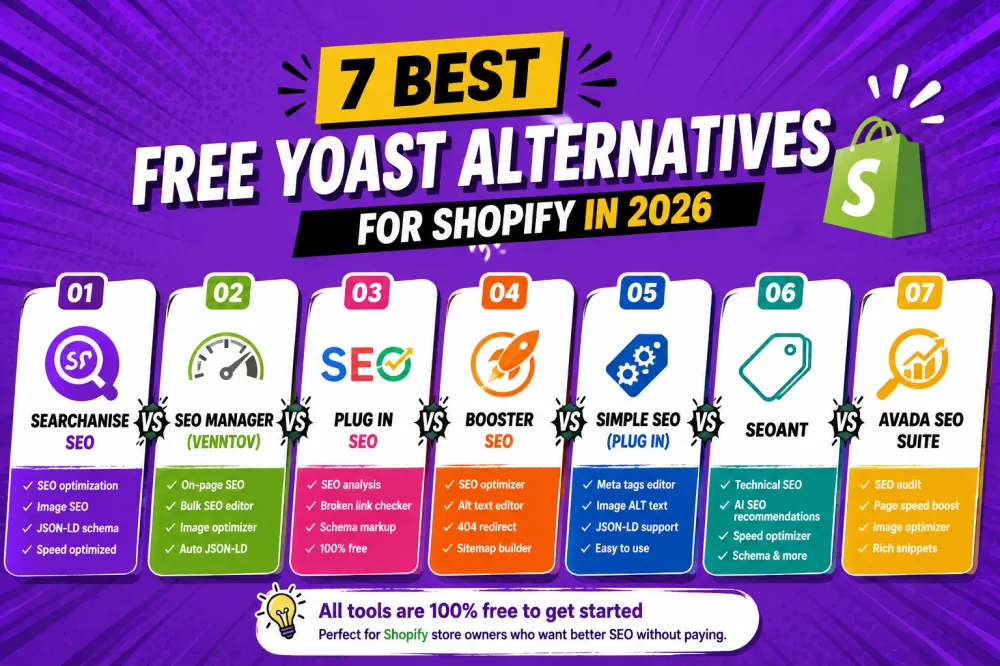
The best Free Yoast Alternatives for Shopify can audit product pages, improve metadata, optimize images, identify broken links and support structured data without requiring an immediate monthly SEO subscription.
Yoast is one of the most recognized SEO tools in the WordPress ecosystem, but its Shopify application follows a different pricing model.
Yoast SEO for Shopify currently costs $19 per month or $190 per year after a 14-day free trial.
The application provides readability analysis, SEO analysis, structured data, technical improvements, bulk editing and educational resources.
Those features may justify the cost for some merchants.
A new Shopify store, however, may need only:
- A basic SEO audit
- Metadata guidance
- Image compression
- Image alt-text optimization
- Broken-link detection
- Basic structured data
- Page-speed recommendations
Several Shopify applications provide some or all of these capabilities through permanent free plans or limited free-to-install models.
This guide compares the strongest options according to their free features, limitations and suitability for different stores.
Free Plan Does Not Mean Unlimited
Some applications are completely free, while others limit the number of images, pages, audits or AI generations. A “free to install” application may also charge when you exceed a usage allowance.
The Quick Verdict
- Best overall free Yoast alternative: SearchPie
- Best feature-rich free plan: Tapita AI SEO Optimizer
- Best balanced on-page SEO tool: Sherpas: Smart SEO
- Best for image optimization and audits: Avada AI SEO Image Optimizer
- Best free-to-install speed tool: TinySEO
- Best completely free image tool: SEO Image Optimizer Wizard
- Best free indexing companion: Bing SEO: IndexNow
Table of Contents
- Free Yoast Alternatives Comparison
- What Does Yoast SEO for Shopify Provide?
- Shopify’s Built-In SEO Features
- 1. SearchPie
- 2. Tapita AI SEO Optimizer
- 3. Sherpas: Smart SEO
- 4. Avada AI SEO Image Optimizer
- 5. TinySEO
- 6. SEO Image Optimizer Wizard
- 7. Bing SEO: IndexNow
- Best Alternative by Purpose
- How to Choose a Shopify SEO App
- Safe Installation Process
- Avoiding Structured-Data Conflicts
- What Free SEO Apps Cannot Do
- Shopify SEO Without a Paid App
- Shopify SEO With Brightery
- Related Brightery Guides
- Resources
- Frequently Asked Questions
Free Yoast Alternatives for Shopify: Quick Comparison
| Application | Free Model | Best Free Features | Main Limitation | Brightery Verdict |
|---|---|---|---|---|
| SearchPie | Permanent free plan | Daily score, metadata templates, 404 detection, basic schema, 50 images and 50 AI tags | Advanced schema and automation require payment | Best overall |
| Tapita AI SEO Optimizer | Permanent free plan | Unlimited on-page audits, basic schema, image compression, metadata and speed tools | Full schema and automatic redirects require payment | Best free feature coverage |
| Sherpas: Smart SEO | Permanent free plan | Metadata, alt tags, sitemap, audits, broken-link checks and AI generations | JSON-LD and page-speed tools are paid features | Best for on-page basics |
| Avada AI SEO Image Optimizer | Permanent free plan | Image optimization, metadata, audits, alt text and basic structured data | Broken-link management and advanced schema are paid | Best for images and auditing |
| TinySEO | Free to install | 50 monthly image optimizations, alt text, filenames and basic speed improvements | Additional images incur usage charges | Best pay-as-you-grow option |
| SEO Image Optimizer Wizard | Free | Image compression, speed support and an SEO audit | Not a complete metadata and schema platform | Best completely free specialist |
| Bing SEO: IndexNow | Free | Automated URL submission through IndexNow | Not an all-in-one SEO application | Best companion application |
Free-plan limits in this table reflect the Shopify App Store listings available when this article was updated.
Always review the current pricing page before installation.
What Does Yoast SEO for Shopify Provide?
Yoast SEO for Shopify is a guided optimization application designed to help merchants improve product, collection, page and blog content.
Current Yoast Shopify Features
- SEO analysis
- Readability analysis
- Automatically added structured data
- Technical SEO improvements
- Bulk-editor import and export
- Educational courses
- Dedicated support
Current Yoast Shopify Price
The current Shopify App Store listing shows:
- $19 per month
- $190 per year
- A 14-day free trial
Yoast does not currently provide a permanent free Shopify plan.
When Yoast May Be Worth Paying For
Yoast may suit merchants who value:
- Familiar traffic-light content guidance
- Readability analysis
- Structured learning resources
- Consistent on-page workflows
- Direct specialist support
When a Free Alternative May Be Enough
A free alternative may be enough when the store needs:
- A basic technical audit
- Limited metadata automation
- Image compression
- Alt-text improvements
- Broken-link monitoring
- Basic schema support
Which SEO Features Does Shopify Already Include?
Shopify provides several technical SEO foundations without requiring Yoast or another third-party application.
Automatically Generated Sitemap
Every Shopify store automatically generates a sitemap.xml file containing products, primary product images, pages, collections and blog posts.
Canonical Tags
Shopify adds canonical tags to help search engines understand the preferred URL for selected pages.
Structured Data
Shopify themes may include structured data for products and other page types.
The exact implementation depends on the theme.
Editable Metadata
Merchants can edit page titles and meta descriptions for products, collections, pages and blog content.
URL Redirects
Shopify provides tools for creating and managing redirects when URLs change or products are removed.
International SEO
Shopify Markets can manage international SEO elements such as hreflang tags, localized URLs, canonical URLs and market sitemaps when configured correctly.
What an SEO Application Should Add
A useful application should improve management, automation, auditing or reporting rather than simply duplicate native code.
1. SearchPie: Best Overall Free Yoast Alternative
SearchPie is one of the strongest free Yoast alternatives because its free plan covers several on-page and technical SEO tasks rather than focusing on only one feature.
SearchPie Free-Plan Features
- Daily SEO-score monitoring
- Basic store and breadcrumb schema
- Sitemap support
- Metadata templates
- Bulk alt-text templates
- Detection of broken links and 404 pages
- Compression of 50 images
- Generation of 50 AI SEO tags
- Basic CSS minification
SearchPie Free-Plan Limitations
Paid plans are required for capabilities such as:
- Product-price and rating schema
- FAQ schema
- Automatic metadata optimization across all pages
- Expanded image optimization
- Advanced AI-search features
- Keyword tracking
Who Should Choose SearchPie?
SearchPie is a good choice for:
- New Shopify merchants
- Small catalogs
- Stores that need an SEO checklist
- Merchants who want metadata and broken-link tools together
Brightery Verdict
SearchPie offers the closest broad free-plan replacement for the essential technical and on-page parts of Yoast.
It does not reproduce Yoast’s complete readability and educational experience, but it provides greater free automation.
2. Tapita AI SEO Optimizer: Best Feature-Rich Free Plan
Tapita combines SEO auditing, image optimization, metadata, speed features and basic AI-search tools in one application.
Tapita Free-Plan Features
- Unlimited on-page SEO audits
- Basic-page audits and LLMs.txt support
- Essential JSON-LD structured data
- Up to 900 image compressions per month
- Bulk and AI metadata optimization
- Alt-text and filename optimization for 50 products
- Instant page-speed functionality
- Support for common SEO issues
Tapita Free-Plan Limitations
Paid plans add:
- Complete structured-data coverage
- Automatic broken-link redirects
- Higher image limits
- More AI metadata credits
- Advanced speed functionality
- Unlimited keyword research
Who Should Choose Tapita?
Tapita may suit:
- Stores with many product images
- Merchants interested in technical audits
- Stores experimenting with AI-search files
- Businesses needing broader free limits
Brightery Verdict
Tapita currently provides one of the most generous free feature sets in this comparison.
Its broad functionality also means merchants should review every automatic change carefully before enabling it.
3. Sherpas: Smart SEO — Best for On-Page SEO Basics
Sherpas: Smart SEO provides a clear free tier focused on metadata, alt tags, audits and limited image optimization.
Smart SEO Free-Plan Features
- Broken-link checks for up to 100 pages
- Optimization of up to 50 images
- 20 AI generations
- Metadata optimization
- Alt-tag optimization
- Sitemap tools
- Noindex-tag management
- Automatic audits for up to 20 pages
Smart SEO Free-Plan Limitations
Important features reserved for paid plans include:
- Page-speed optimization
- JSON-LD implementation
- Bulk metadata editing
- Bulk alt-tag editing
- Expanded audit limits
- Multilingual SEO tools
Who Should Choose Smart SEO?
Smart SEO is suitable for:
- Small Shopify catalogs
- Merchants prioritizing metadata
- Stores needing basic audit guidance
- Businesses that may upgrade gradually
Brightery Verdict
Smart SEO provides a practical, clearly limited free plan.
It is less comprehensive than SearchPie or Tapita at no cost, but its interface and focused feature set may be easier for merchants who need only the essentials.
4. Avada AI SEO Image Optimizer: Best for Audits and Images
Avada combines image optimization, metadata, on-page auditing, speed support and basic structured data.
Avada Free-Plan Features
- Optimization of 100 images
- Basic speed booster
- HTML sitemap
- Metadata tools
- 20 on-page audits
- 100 AI credits
- Basic Google structured data
- Image alt-text optimization
Avada Free-Plan Limitations
The free plan does not include the complete versions of:
- Broken-link management
- URL optimization
- Advanced structured data
- Unlimited audits
- Advanced speed optimization
- Robots.txt editing
Who Should Choose Avada?
Avada is particularly useful for:
- Image-heavy product catalogs
- Stores needing a quick on-page review
- Merchants who want AI assistance with metadata
- Businesses using supported product-review applications
Brightery Verdict
Avada is a strong option when product images and page audits are the immediate priorities.
Stores should review their theme’s existing structured data before enabling Avada schema.
5. TinySEO: Best Free-to-Install Speed and Image Tool
TinySEO is a broad SEO and speed application, but its entry-level model is best described as free to install rather than completely free.
TinySEO Free Allowance
- 50 free image optimizations each month
- Alt-text optimization
- Filename optimization
- Instant speed improvements
- PageFly image support
- 30-day image backup
Usage Charges
The current listing charges for image optimizations above the free monthly allowance.
Paid TinySEO Features
- Expanded image allowances
- Extended JSON-LD
- Lazy loading
- Broken-link detection
- Automatic redirects
- AI metadata generation
- Advanced Search Console insights
Who Should Choose TinySEO?
TinySEO is appropriate for:
- Small stores adding a limited number of images monthly
- Merchants who prefer usage-based growth
- Stores focused on image size and page speed
- Businesses that may need advanced tools later
Brightery Verdict
TinySEO is not a fully free Yoast replacement, but its monthly allowance is useful for small stores with controlled image volume.
6. SEO Image Optimizer Wizard: Best Completely Free Specialist
SEO Image Optimizer Wizard is a narrower tool than Yoast, SearchPie or Tapita.
It focuses primarily on image optimization, website speed and general SEO reporting.
Main Features
- Image optimization
- Image compression
- Website-speed improvements
- SEO audit and recommendations
- Action items for business, marketing and technical issues
Main Limitation
The application is not a complete replacement for advanced:
- Metadata management
- Structured-data governance
- Keyword strategy
- Internal-link planning
- Content optimization
Who Should Choose It?
It is best for small merchants who want a completely free, focused image-optimization application and a basic SEO report.
Brightery Verdict
Use it as a specialist image tool rather than expecting it to replace a complete ecommerce SEO workflow.
7. Bing SEO: IndexNow — Best Free Indexing Companion
Bing SEO: IndexNow is not a direct Yoast alternative.
It solves one specific problem: notifying supported search engines when Shopify URLs are created or changed.
Main Features
- IndexNow URL submission
- Automatic notification for products
- Automatic notification for collections
- Automatic notification for blog posts
- Bulk URL submission
What IndexNow Does Not Do
- It does not optimize content
- It does not guarantee indexing
- It does not improve rankings automatically
- It does not replace Google Search Console
- It does not provide complete metadata or schema management
Who Should Use It?
It can be a useful free companion for stores that publish or remove products frequently and want to notify IndexNow-supported search engines efficiently.
Brightery Verdict
Add it only when IndexNow is part of a wider SEO process. Do not mistake faster notification for guaranteed organic visibility.
Which Free Shopify SEO App Is Best for Each Purpose?
| Requirement | Recommended Application |
|---|---|
| Closest general free Yoast alternative | SearchPie |
| Largest free image allowance | Tapita |
| Basic metadata and alt tags | Sherpas: Smart SEO |
| Free on-page auditing | Tapita or Avada |
| Completely free image optimization | SEO Image Optimizer Wizard |
| Pay-as-you-grow image optimization | TinySEO |
| Bing and IndexNow submission | Bing SEO: IndexNow |
| Readability analysis similar to Yoast | Yoast remains the more direct option |
| Complete professional SEO strategy | An experienced Shopify SEO specialist or agency |
How to Choose a Free Yoast Alternative for Shopify
Start With the Store’s Actual Problem
Do not install an all-in-one application simply because its feature list is long.
Identify whether the store’s primary problem is:
- Missing metadata
- Large images
- Broken links
- Weak product descriptions
- Missing structured data
- Poor indexing
- Slow page performance
Check the Free Limits
Compare limits according to the size of your catalog.
A plan allowing 50 optimized images may be sufficient for a ten-product store and unsuitable for a catalog containing thousands of products.
Review Data Access
Read the application’s data-access section and privacy policy.
Install only applications whose requested access is reasonable for their functionality.
Review Uninstallation Behavior
Determine which changes remain after the application is removed.
Some application-managed metadata, structured data or theme code may be removed or require cleanup.
Review Support and Update History
A free application still affects a production store.
Check recent updates, merchant feedback, compatibility and the developer’s support process.
How to Install a Shopify SEO App Safely
1. Audit the Existing Store
Record current metadata, structured data, redirects, page speed and organic traffic before installation.
2. Duplicate the Theme
Create a backup copy of the live Shopify theme before enabling theme-level optimization.
3. Check Existing SEO Applications
Remove or disable overlapping functionality carefully. Do not allow several applications to manage the same schema.
4. Review Application Permissions
Check the products, themes, customer data and storefront information the application can access.
5. Enable One Feature at a Time
Begin with auditing and reporting before enabling bulk automated changes.
6. Test Important Pages
Review the homepage, collections, products, articles, cart and checkout on desktop and mobile.
7. Validate Structured Data
Use suitable testing tools to identify duplicated or invalid schema.
8. Monitor Performance
Compare page speed, indexing, errors and organic performance after implementation.
Avoid Structured-Data Conflicts
Structured data helps search engines understand products, prices, availability, reviews, businesses and website relationships.
Shopify themes and product-review applications may already produce structured data.
Installing another SEO application can create duplicated:
- Product schema
- Offer schema
- AggregateRating schema
- Breadcrumb schema
- Organization schema
Why Duplicate Schema Is a Problem
Multiple versions can contain conflicting prices, availability, review totals or product information.
Before Enabling Schema
- Inspect the theme’s current markup
- Check review-application markup
- Choose one primary schema source
- Disable duplicated output where possible
- Validate important templates
An application should not be judged by how many schema types it can add, but by whether it adds accurate and non-conflicting data.
What Free Shopify SEO Apps Cannot Do
An application can automate selected tasks, but it cannot create a complete search strategy without business and market knowledge.
Keyword Strategy
Software may suggest keywords, but it cannot automatically decide which search intent should map to each product, collection, landing page and article.
Category Architecture
The store still needs a logical structure based on customer demand and product relationships.
Original Product Content
Automatically generated descriptions require review for accuracy, differentiation, brand tone and usefulness.
Internal Linking
Merchants must intentionally connect guides, collections, products and comparison pages.
Authority and Backlinks
No application can replace public relations, partnerships, useful resources and legitimate link earning.
Conversion Optimization
Organic traffic does not create revenue when product pages, navigation, pricing or checkout are weak.
Brightery’s ecommerce SEO guide explains the broader work required beyond installing an application.
Can You Optimize Shopify Without Yoast or Another Paid App?
Yes. A Shopify store can perform many essential SEO tasks without a paid application.
Manual Shopify SEO Checklist
- Connect Google Search Console
- Submit the Shopify sitemap
- Research commercial and informational keywords
- Create a logical collection structure
- Write unique product titles and descriptions
- Optimize page titles and meta descriptions
- Compress product images before upload
- Add useful image alt text
- Create redirects when URLs change
- Publish useful buying guides
- Add contextual internal links
- Improve mobile page performance
- Review indexing and crawl errors
- Earn relevant links and brand mentions
When an Application Helps
Applications become valuable when they reduce repeated work, detect problems at scale or make monitoring easier.
When an Application Is Not Enough
Stores competing for valuable national or international searches usually need technical SEO, content planning, digital PR, analytics and conversion optimization.
Shopify SEO and Development With Brightery
Brightery helps Shopify merchants choose and configure SEO tools according to the store’s catalog, theme and growth strategy.
Brightery Shopify SEO Services
- Technical Shopify SEO audits
- Keyword and competitor research
- Collection architecture
- Product-page optimization
- Blog and content strategy
- Internal-link planning
- Structured-data review
- Redirect and migration management
- Page-speed optimization
- Google Search Console monitoring
- AI-search and product-discovery preparation
Application Selection and Cleanup
Brightery can audit installed Shopify applications, identify overlapping SEO features and remove unnecessary scripts or conflicting structured data.
Shopify Development
SEO often requires theme, navigation, content-template and product-data improvements that cannot be solved through an application alone.
Learn how a Shopify Partner can support store development, integrations and organic growth.
Enterprise Shopify
Larger brands can review Brightery’s Shopify Plus Partner guide for international stores, integrations and scalable SEO architecture.
Related Brightery Shopify, Ecommerce and SEO Guides
Shopify Development
Ecommerce SEO
- Complete Ecommerce SEO Guide
- Complete SEO Marketing Guide
- How to Write SEO Content
- Complete Off-Page SEO Guide
Ecommerce Development
- Brightery Ecommerce Development Services
- Custom Ecommerce Development
- Ecommerce Development Agency Guide
- Ecommerce Development Solutions
Website Performance and Growth
Final Verdict
Yoast remains a recognizable guided SEO product, especially for merchants who value readability feedback, educational resources and structured optimization.
It is not the only useful Shopify SEO application.
SearchPie currently provides the strongest general free alternative, while Tapita offers one of the broadest free feature sets.
Smart SEO is suitable for focused metadata work, Avada is strong for images and audits, and TinySEO provides a practical free-to-install model for smaller stores.
SEO Image Optimizer Wizard and Bing IndexNow are useful specialist tools but should not be considered complete Yoast replacements.
The best Shopify SEO application is the one that solves a verified store problem without creating unnecessary code, duplicate schema or continuing technical dependency.
The application should support your SEO strategy—not become the strategy itself.
Improve Your Shopify SEO With Brightery
Brightery helps Shopify stores improve technical SEO, collection architecture, product content, internal links, structured data, speed and organic conversion.
Our team can also audit installed SEO applications and determine which tools should be kept, replaced or removed.
Resources
External references are separated here so they can be removed easily before publication.
- Yoast SEO for Shopify
- SearchPie
- Tapita AI SEO Optimizer
- Sherpas: Smart SEO
- Avada AI SEO Image Optimizer
- TinySEO
- SEO Image Optimizer Wizard
- Bing SEO: IndexNow
- Shopify SEO Overview
- Shopify Sitemap Documentation
Frequently Asked Questions
Is Yoast SEO Free for Shopify?
No permanent free plan is currently listed. Yoast SEO for Shopify costs $19 per month or $190 per year after a 14-day free trial.
What Is the Best Free Yoast Alternative for Shopify?
SearchPie is the strongest general free alternative in this comparison because its free plan includes metadata templates, broken-link detection, basic schema, auditing and limited image optimization.
Which Shopify SEO App Has the Best Free Plan?
Tapita offers one of the broadest free plans, including unlimited on-page audits, essential schema, metadata tools, image compression and basic speed features.
Does Shopify Need an SEO Application?
Not necessarily. Shopify already provides sitemaps, canonical tags, editable metadata, redirects and selected structured data. An application is useful when the store needs additional auditing, automation or monitoring.
Can I Use Two Shopify SEO Apps Together?
It is technically possible, but overlapping applications may create duplicated metadata, scripts or structured data. Use one primary application for each SEO function.
Do Free SEO Apps Improve Shopify Rankings Automatically?
No. They can identify problems and automate selected tasks, but rankings also depend on search intent, content quality, store structure, links, performance and competition.
Which Free Shopify App Is Best for Image SEO?
SEO Image Optimizer Wizard is a useful completely free specialist. Tapita and Avada also provide image optimization through broader free SEO plans.
Which Free Shopify App Finds Broken Links?
SearchPie and Smart SEO include limited broken-link checks in their free plans. Exact limits should be verified before installation.
Can a Free SEO App Add Product Schema?
Some free plans provide basic structured data, but advanced product, review, FAQ or merchant schema may require payment. Check the theme’s existing schema before adding another source.
Will Removing an SEO App Damage My Shopify Store?
It depends on how the application applies its changes. Some app-managed metadata, schema or theme code may disappear or require cleanup after removal.
Can Brightery Optimize a Shopify Store Without Yoast?
Yes. Brightery can optimize Shopify metadata, collections, products, content, internal links, structured data, page performance and Search Console reporting without depending on Yoast.
0 Responses
Share your perspective and continue the conversation.
No responses yet
Be the first to share your thoughts.
Join the conversation